Verification of Payee: What 'No Match' Means, and Why Ignoring It Costs You Your Refund
Verification of Payee checks the name against the IBAN before you send. What match, close match and no match mean — and who pays if you override it.

Since 9 October 2025, every bank in the euro area has to check the name you typed against the account you're paying, and show you the answer before the money leaves. You'll get one of four results: match, close match, no match, or verification not possible. Most people click past it.
Here's the part banks bury in the terms: if you get a warning and send the money anyway, you have knowingly authorised the payment. That changes who carries the loss. Override the warning, and the refund is no longer your bank's problem.
That's the whole reason this screen deserves three seconds of your attention rather than a reflexive tap.
What each result actually means
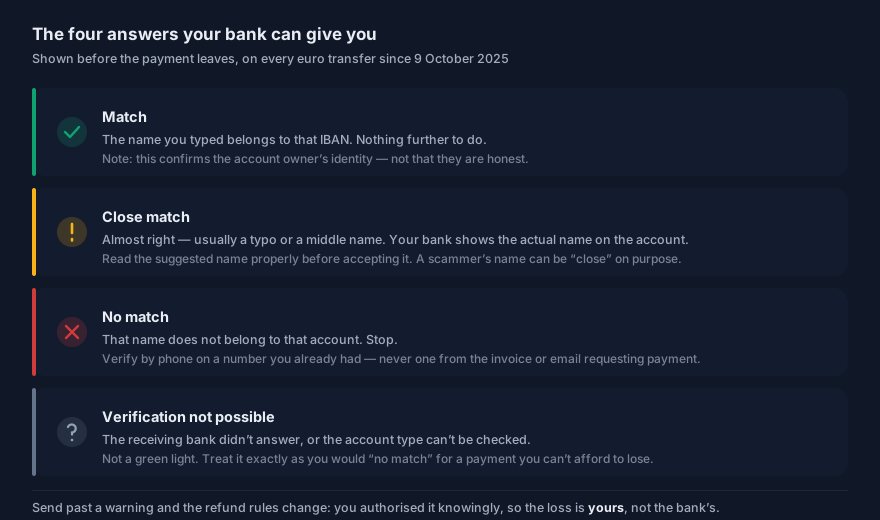
The wording differs slightly between banks, but the four outcomes are defined by the regulation, so the meaning is identical whether you bank with a high-street name or a neobank.
| Result | What it means | What to do |
|---|---|---|
| Match | The name belongs to that IBAN | Send |
| Close match | Nearly right — usually a typo or a missing middle name. Your bank shows you the real name | Read the real name, then decide |
| No match | That name does not belong to that account | Stop and verify another way |
| Verification not possible | The receiving bank didn't respond, or the account can't be checked | Treat as unverified, not as approved |
Why this exists
Because bank transfer fraud got out of hand, and because the people losing the money were authorising it themselves.
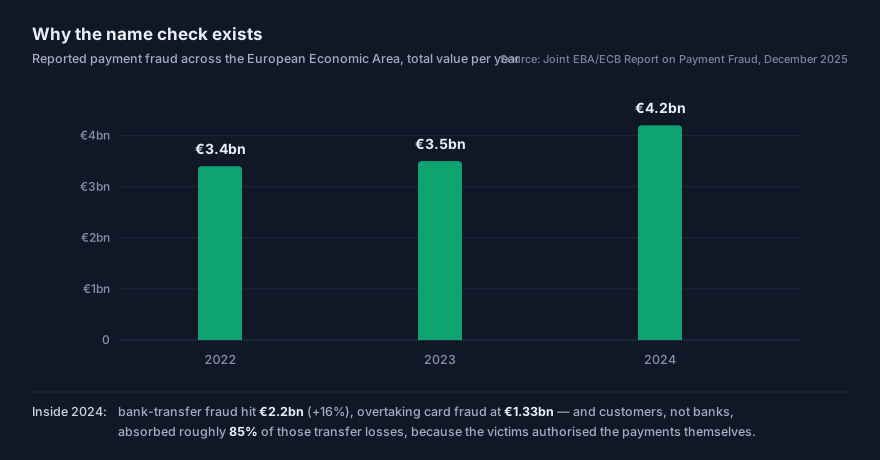
The joint EBA/ECB Report on Payment Fraud put total reported payment fraud across the European Economic Area at €4.2 billion in 2024, up from €3.5 billion the year before. Within that, fraudulent credit transfers reached €2.2 billion, a 16% rise, comfortably overtaking card fraud at €1.33 billion.
The number that drove the regulation is the next one. For credit transfers, payment service users bore roughly 85% of the losses — not the banks. Card fraud has strong customer authentication and clear chargeback rights; bank transfers had neither, because from the bank's side a transfer you approved yourself looks exactly like a transfer you meant to make.
The name check is the first systematic attempt to break that. It puts a moment of friction between "I've typed the IBAN from this email" and "the money is gone in ten seconds."
Which brings up the other half of the same law. Since January 2025 euro transfers must arrive within ten seconds, at any hour, and since October banks may not charge more for an instant transfer than a standard one. That's genuinely good — but it also removed the accidental safety net that slow payments used to provide. There is no longer a business day in which to notice the mistake and phone the bank. The name check exists because the undo button doesn't.
The liability shift nobody reads
Under the Instant Payments Regulation, banks must tell you what happens if you ignore a warning. In practice that disclosure is a line of small print, and the consequence is significant.
If the check returns no match or verification not possible, and you choose to proceed, you have made an informed decision to pay an account the bank told you looked wrong. Your refund rights afterwards are dramatically weaker — in most cases, gone. The bank did its job by warning you.
This cuts both ways, and it's worth knowing the upside too: if your bank failed to offer the check, or showed you a "match" that was wrong, that's the bank's failure and your position is much stronger. The obligation is on them to provide the service correctly.
So the practical rule is short. A warning screen is not an inconvenience between you and your payment. It is the moment your protection ends.
What it does not protect you against
This is the part most coverage skips, and it matters more than everything above.
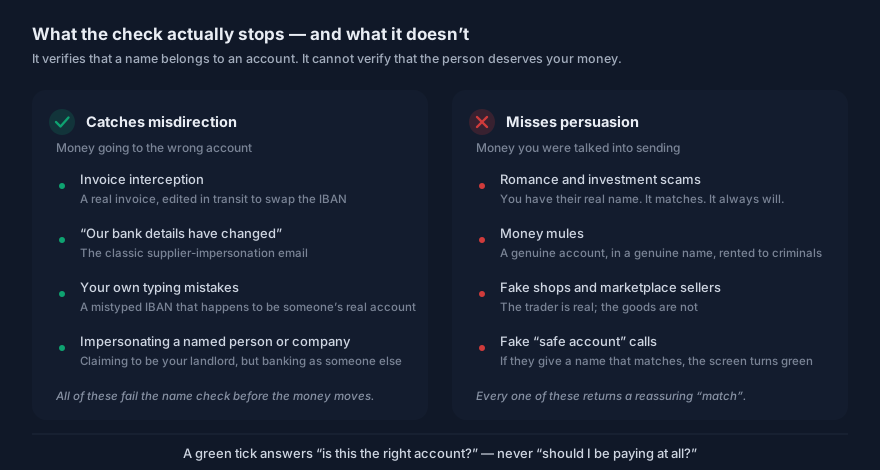
Verification of Payee answers exactly one question: does this name belong to this account? It does not, and cannot, answer should I be sending this money at all?
Every scam that works by persuading you rather than misdirecting you sails straight through with a green tick:
- Romance and investment scams. You have their real name. You're paying their real account. Match.
- Money mules. A genuine account in a genuine name, rented or coerced from a real person. Match.
- Fake online sellers. The trader exists, the bank details are theirs, the goods don't exist. Match.
- "Your account is compromised, move your money to this safe account." If the caller supplies a name that matches the receiving account, the screen goes green and the reassurance is worse than useless.
Given that manipulating the payer is precisely the fraud type the ECB flags as growing, this limitation isn't academic. The check fixes the fraud where money went to the wrong account. It does nothing about the fraud where you were talked into sending it to the right one.
What to do when you see a warning
Don't verify using the details in front of you. If an invoice, email or text prompted this payment, every contact detail on it is suspect — including the phone number. Use a number you already had, from a previous letter, a contract, or the organisation's official website typed in yourself. Ring the actual person for anything large. A supplier changing their bank details is the single most common business-payment fraud, and a thirty-second call to a known number defeats it. Say the account number out loud and have them confirm it. Send €1 first for a new payee. Then confirm by phone that it arrived, then send the rest. On a five-figure transfer this is trivially worth the delay. Treat "verification not possible" as unverified. It's a technical non-answer, not an approval. For a payment you can't afford to lose, that's the same as a warning. Slow down when you feel rushed. Urgency is the raw material of every one of these scams. No legitimate organisation loses your money because you took an hour to check.Frequently asked questions
What does "close match" mean on a bank transfer?
Close match means the name you entered is nearly, but not exactly, the name registered to that account — most often a typo, an abbreviation, or a missing middle name. Your bank will show you the actual account name so you can compare and correct it.
It's usually harmless. The caution is that fraudsters deliberately use names that are close to a legitimate one, because a small discrepancy is easy to dismiss. Read the name your bank displays rather than assuming it's the one you expected.
What happens if I ignore a "no match" warning and send the money anyway?
You take on the liability. Proceeding past the warning means you knowingly authorised a payment your bank flagged as going to an unverified account, and in most cases that removes your grounds for a refund if it turns out to be fraud.
Banks are required to explain this before you confirm, but the explanation is typically brief and easy to miss. In practice, "no match" should be treated as a stop, not a speed bump.
Does Verification of Payee stop all bank transfer fraud?
No. It only checks whether the name matches the account, so it stops fraud that relies on redirecting money to the wrong account — altered invoices, fake "our details have changed" emails, mistyped IBANs. It does nothing about scams where you're persuaded to pay the correct account of a genuine criminal.
Romance scams, fake investments, purchases from fraudulent sellers and money-mule accounts all return a perfectly clean "match". A green result confirms the destination, never the decision.
Which payments does the name check apply to?
It applies to euro credit transfers within the EU and EEA, both instant and standard, made through payment service providers covered by the Instant Payments Regulation. That includes banks, e-money institutions and payment institutions. The other change coming to euro payments is a new form of the currency itself — see what the digital euro actually changes.
It runs before you confirm, so you see the result while you can still act on it. Existing standing orders and direct debits work differently — the check is aimed at the moment you set up or send a transfer.
Can I be charged extra for an instant transfer?
No. Since the regulation took effect, a payment provider may not charge more for an instant euro transfer than it charges for an equivalent standard one. If you're still paying a premium for speed, that's worth querying, and worth comparing against other providers — the same logic that applies to any recurring bank cost.
The one-line version
The name check is a genuine improvement, and it closes a real gap that was costing Europeans billions a year. But it protects against the wrong account, not the wrong decision — and the moment you click past a warning, the responsibility moves to you.
Read the screen. It's three seconds, and it's the last point at which the money is still yours. If losing a transfer would be a genuine emergency rather than an annoyance, that's a separate problem worth fixing too — an emergency fund is what turns a disaster into a setback.
Sources
- ECB — Joint EBA/ECB report on payment fraud (December 2025)
- EBA/ECB — 2025 Report on Payment Fraud, full PDF
- ECB — Instant Payments Regulation overview
- European Commission — New EU rules make instant euro payments faster and safer
- PwC Legal — Verification of Payee requirements under the IPR
- Taylor Wessing — Verification of Payee requirements start to apply
I build Portofelo, an offline-first expense tracker for iPhone. I've spent more hours than I'd like to admit inside other people's budgeting apps, and I write about what actually works.
All articles by Elena Marek →Related articles
Start tracking your finances today
Portofelo makes budgeting and expense tracking effortless. Free to download.
Get Portofelo Free